
7 Key Benefits of Managed IT Services for Your Business

An in-house IT staff isn’t for every business, and it can drain productivity from other critical areas. Here are 7 benefits of using managed IT services.


Managing an in-house IT department isn’t for every business, especially startups. Time and resources spent on day-to-day technology needs can drain the productivity of even the most streamlined staff. Strategic outsourcing of some or all of your IT needs can make or break performance in the major areas both in the near and long term. The following are seven of the most significant benefits that managed IT services can bring to your company:

1. Automating Regular IT Tasks

With the help of virtualisation, managed IT can take care of common areas and components like email, helpdesk support, server and network oversight, and more.
 With so much reliance on IT, outsourcing “mundane” tasks will free up your staff for more creative and innovative roles.

2. Continuous IT Systems Supervision

Proactive monitoring of the primary business components can help with avoiding major issues and catching them early when they’re small. While a network crash could take mission-critical resources offline for an extended time period, effective monitoring and maintenance will help detect potentially problematic issues early. From a router that’s about to fail to server problems, these red flags can be addressed by your dedicated IT partner before they reach the stage of a disastrous outage.

3. Cost-Effective IT Management

IT budgets can be substantial, but costs can be better managed and ultimately reduced by using an IT services professional. Instead of paying on the fly for every issue that comes up (and risking steep, unexpected bills), you’ll instead have one flat fee that will cover your most essential services.

4. Tapping into IT Professional Expertise

With managed IT services, your business will automatically gain access to highly skilled staff who are trained and equipped to handle unforeseen issues and special circumstances. Your company will be backed by a dynamic infrastructure, stable operations, and an experienced technical support team.

5. The Impact of Centralised IT Operations

A managed IT network can include the consolidation of all servers and applications within distributed data centres. This, in turn, results in improved staff performance both in-house and from remote locations. Centralised data ensures easy network access to storage, virtual services, and backup infrastructure. Centralisation also reduces your company’s carbon footprint.

6. Enhancing IT Support Efficiency

When issues arise, your business requires fast, targeted support. IT service providers are motivated to act quickly due to the costs associated with production. Put simply, it’s in your Managed Service Provider’s best interests to address and repair each client’s technical issues efficiently, making timely support a win-win for both of you.

7. Safeguarding Business Continuity

Your Managed Service Provider has designed their data centres and networks to be reliable and resilient for their clients. Because of this, you can rest assured your business will experience maximum uptime and continuity. Their significant technological investment means that even if disaster strikes, your business data and digital communications will be preserved.

Not every business is ready for full-time in-house IT staff. Others might benefit from outsourcing portions of their IT requirements. Resources directed toward IT could cost you in other areas; however, with strategic use of managed IT services, your business can flow and evolve dynamically. Consider how these seven benefits of managed IT services could impact your company for the better.

The Transformative Power of Managed IT Services

The benefits of managed IT services extend far beyond mere convenience. From automating routine tasks to ensuring IT disaster recovery, these services can significantly enhance your business operations, making them more efficient, reliable, and cost-effective.

However, the key to reaping these benefits lies in choosing the right IT partner. At Inspired IT, we bring a wealth of expertise and a commitment to delivering tailored IT solutions that align with your unique business needs. Our team is ready to help you navigate the complexities of IT management, allowing you to focus on what you do best – running your business.

Don’t let IT challenges hold your business back. Contact Inspired IT today and let us help you unlock the full potential of your business through strategic IT management. Your journey towards enhanced business performance starts here.

Ransomware will remain top of hackers’ minds in 2017

Ransomware was one of the most successful vectors for cyber attacks in 2016. Cyber security experts predict it will continue during 2017. What can business and private citizens do to keep themselves safe online?

Cyber security experts predict it will continue during 2017. What can business and private citizens do to protect themselves online?

“Ransomware is going to continue to be a major problem and, in fact, will probably get worse in 2017.”…USA Today, Jan. 3, 2017

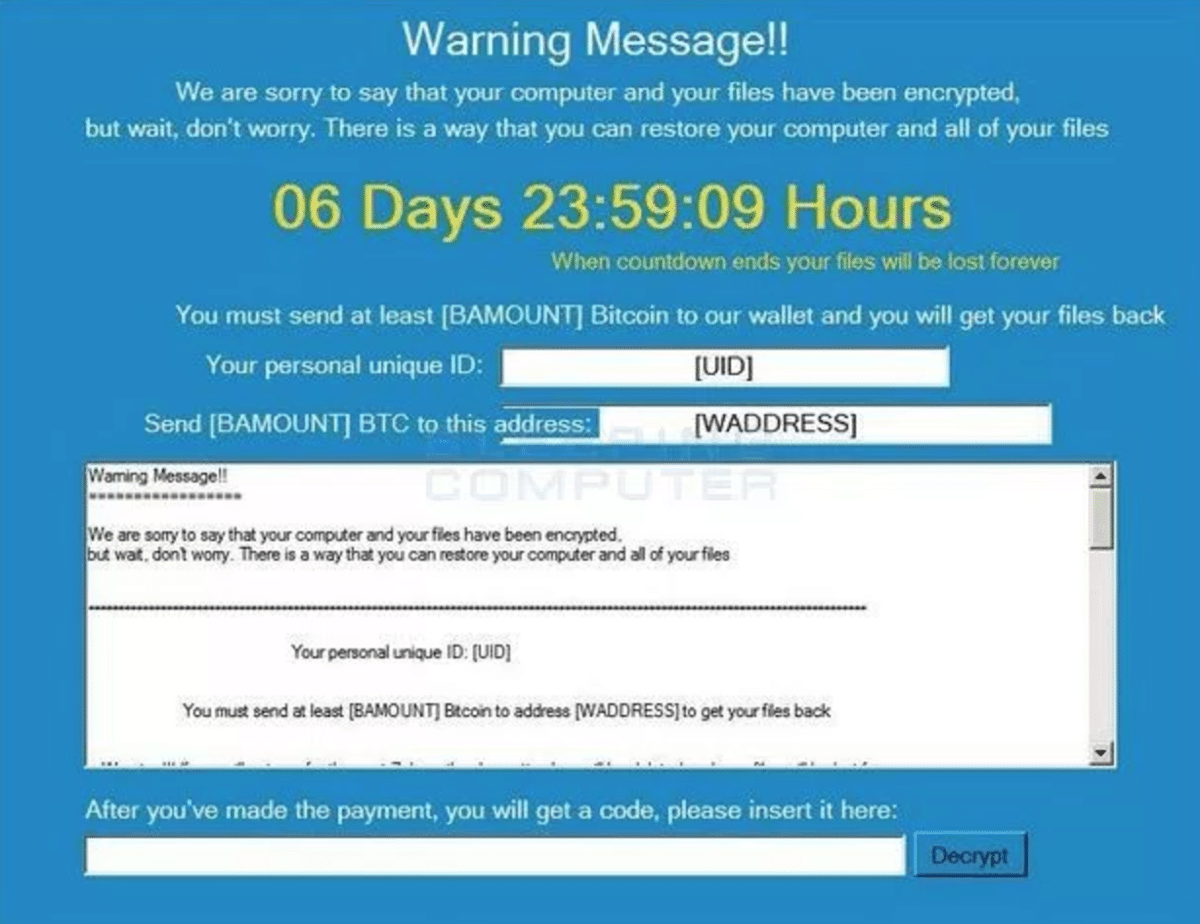
Anyone concerned about security and having just returned from a year’s sabbatical in the Himalayas may not have heard about ransomware. Everyone else knows that ransomware is a sophisticated denial of service attack. The victim opens an innocent looking email attachment or clicks on a link, at which point the attached malware encrypts the victim’s files. The hacker demands a ransom in exchange for (maybe) sending the encryption key to unlock the files.


2017 will see more attacks

The attacks will undoubtedly continue. Criminals go where the money is, and, according to this piece on Business Insider, an especially sophisticated ransomware strain has resulted in $325 million in ransom payments.

The ransomware business model

Ransomware has characteristics of legitimate business practices. Harriet Taylor writing for CNBC.Com points out that the hackers “business plan” employs the following:

  • Ransomware criminals go after “large markets with affluent customers.” Rather than lose valuable business files, the victims balance a moderate (and sometimes negotiable) ransom payment against the time and cost of restoring their system.
  • The cyber criminals provide a product “with a clear value proposition.” The value is that returning the seized data “alleviates a particular pain point,” i.e., the stoppage of business.
  • Like most successful entrepreneurs, ransomware hackers “act with agility and stealth.” They outwit their anti-malware competitor software through ever-changing tactics.
  • They employ a “profit-sharing” strategy through a new twist known as Ransomware as a Service. Low-tech criminals subscribe to the service, entrap unwary victims, and give the original ransomware coders a cut of the take.

Cyber self-protection in 2017

The USA Today piece mentioned above has some sensible advice on what everyone can do in the new year to avoid having their data kidnapped as well as to be more secure in cyberspace:

  • Employ the first line of defense by remaining suspicious of unfamiliar email links or attachments. Also be wary of innocent looking online ads, which can also be planted and tainted with malware on the web.
  • Remember that ransomware also targets individuals as well as businesses and public agencies. Everyone is at risk.
  • Institute strong password practices; e.g., dual authentication, letter-number-symbol combinations, passphrases, etc.
  • Always backup everything regularly on an off-line, external hard drive. For extra insurance invest in secure cloud backup services.

Businesses need to go a few steps further

The Department of Homeland Security also recommends a “commitment to cyber hygiene” along with best practices for protecting enterprise networks. In addition to backups, these methods include:

  1. a cybersecurity risk analysis for the organization
  2. staff training on cyber security
  3. patching vulnerable system software
  4. allowing only approved programs to run on the network
  5. a realistic and tested incident response plan
  6. an efficient and compliant business continuity plan
  7. testing the system by periodically attempting to hack into it

Should victims pay the ransom?

It is entirely up to the victim to decide whether paying the ransom is preferable to continuing the “pain” of business stoppage. However, the Department of Homeland Security cites “serious risks” to consider before paying a ransom demand:

  • Payment of the ransom is no guarantee that the criminal will give back the data.
  • Victims can be re-targeted after paying the first demand.
  • Paying the initial demand could result in demand for a ransom increase.
  • Ransom payments encourage the continuation of the ransomware business model.

Looking for the best defense against cyber attacks? {company} is your {city} leader in cyber security. Contact us at {phone} or {email}.

Exporting Dynamics NAV Database on SQL Server 2016: the How-To

Before you run anything through SQL Server 2016 for your Dynamics NAV database, make sure you update everything.

Before you export a database to the .bacpac format, if you are using the SQL Server 2016 for your Dynamics NAV database, you need to make sure you are running the latest update from August 2016 or later. You should check with your Microsoft SQL Server Data-Tier Application Framework (DacFx) or SQL Server Management Studio (SSMS). If you don’t you run the risk of exposing your system to a bug in the tools around SQL Server that Microsoft has located.


The Error Message

During one of their tests, Microsoft found out that the Dynamics NAV 2017 demo database couldn’t be exported to a .bacpac file.

"c:Program FilesMicrosoft SQL Server130DACbinSqlPackage.exe" /Action:Export /TargetFile:nav-test.bacpac /SourceServerName:10.0.0.10 /SourceDatabaseName:"Demo Database NAV (10-0)" /SourceUser:sa /SourcePassword:blablabla
 Connecting to database 'Demo Database NAV (10-0)' on server '10.0.0.10'.
 Extracting schema
 Extracting schema from database
 Resolving references in schema model
 Validating schema model
 Validating schema model for data package
 Validating schema
 *** Error exporting database:One or more unsupported elements were found in the schema used as part of a data package.
 Error SQL71564: View: [dbo].[CRONUS International Ltd_$Service Shipment Buffer$VSIFT$0] contains a statement that is not supported on Microsoft Azure SQL Database v12. The specific error is: Incorrect syntax near "CRONUS International Ltd_$Service Shipment Buffer$VSIFT$0".
 Error SQL71564: View: [dbo].[CRONUS International Ltd_$Calendar Entry$VSIFT$0] contains a statement that is not supported on Microsoft Azure SQL Database v12. The specific error is: Incorrect syntax near "CRONUS International Ltd_$Calendar Entry$VSIFT$0".
 ...

They found that the view that had the erros in code was used for a SIFT index. They were not sure where exactly the problem was in the code but they had a hypothesis that it might be hidden in the .bacpac report. They then tested it by creating an empty database with a table and a view using the same syntax that was found in the view with the error.

IF OBJECT_ID(N'id_v', N'V') IS NOT NULL
DROP VIEW id_v
GO
DROP TABLE IF EXISTS id
GO 
CREATE TABLE id(n int)
GO 

CREATE VIEW id_v AS
SELECT "abc".n FROM dbo.id "abc"
GO

But this export still triggered the error.

"c:Program FilesMicrosoft SQL Server130DACbinSqlPackage.exe" /Action:Export /TargetFile:nav-test.bacpac /SourceServerName:10.0.0.10 /SourceDatabaseName:dacpac-test /SourceUser:sa /SourcePassword:blablabla
Connecting to database 'dacpac-test' on server '10.0.0.10'.
Extracting schema
Extracting schema from database
Resolving references in schema model
Validating schema model
Validating schema model for data package
Validating schema
*** Error exporting database:One or more unsupported elements were found in the schema used as part of a data package.
Error SQL71564: View: [dbo].[id2_v] contains a statement that is not supported on Microsoft Azure SQL Database v12. The specific error is: Incorrect syntax near "abc".

The error message indicated that the sqlpackage had a problem with quoted identifiers and Microsoft immediately contacted the SQL Server Team to report a bug. The team confirmed that this was, in fact, a bug and that it had been fixed in the July update of DacFx.

If you haven’t already, you need to install the update. You can run this to get the latest update:

Register-PackageSource -Name NuGet -Location https://www.nuget.org/api/v2 -Provider NuGet -Verbose
Install-Package -Name Microsoft.SqlServer.DacFx.x64 -MinimumVersion 130.3485.1 -ProviderName NuGet -Force

At {company}, we are always here to help. For more information about this and other issues you may be having, be sure to contact us in {city} by calling us at {phone} or emailing us at {email}.

Hacked Off: Safeguarding Your Business From Data Breaches

Bad outsourcing decisions are often the cause of damaging data breaches, learn how to minimize your company’s risks

Arguably, the whole world is aware of the global issues of data breaches, from Wikileaks to Yahoo. The ramifications of once private or encrypted information falling into the public sphere has implications for individuals and businesses around the world.


Trustwave, a digital security firm, has found that poor outsourcing decisions leads to at least two-thirds of data breaches. In 2013, the firm released a report linking third-party IT system providers or administrators to 63% of the 450 cases of global data breaches the company was investigating that year. The research points to weaknesses in third party IT support, maintenance and development that have been quickly exploited by computer hackers. This proves the need to make considered and researched decisions when choosing an IT service provider to outsource your business to.

Often times businesses fail to fully understand the price of security risks that could impact on their operations, and they aren’t stringent enough in considering how third party suppliers might handle their sensitive data. Instead many consider the most economical provider that can deliver on the bottom line, but this could cause long term issues down the road in terms of protecting digital information.

Many large Fortune 500 companies give consideration to digital security risks in their annual reports, but many companies fail to demonstrate this right down to the level of procurement and negotiation.

It is also rare that IT security providers and managers are included in negotiation talks when signing off on IT service outsourcing. Most conversations revolve around price and service level agreements (SLAs) and fail to encompass security concerns. This can be improved upon by establishing protection expectations and searching for third party proposals that give consideration to your concerns.

Asking critical questions is a great start, but it should be backed up with a full evaluation process that will properly collate information and confirm security claims in acknowledgement of your questions. This should be both backed up by paper-based evidence and conversations to ensure proper accordance to standards.

Cutting corners with an IT service provider may seem like a wise short term decision, but in the long run, data breaches could cost vast amounts of time and money in the future. Third party providers do offer the benefit of specialist knowledge and servicing to properly handle your IT solutions, but a certain level of trust should be managed between your provider and your organization. Educating yourself on potential weaknesses will help you establish a preferred mode of working with your provider. Looking for third party verification that your provider is both honest and well informed on security methods is essential.

If your organization deals with payments and card systems, your provider should be able to demonstrate evidence of PCI DSS (payment card industry data security standards) compliance by a Qualified Security Assessor (QSA). By understanding your risks and working to minimize breaches through smarter IT service provider selection you can help to safeguard your business from damaging data leaks in the long run.

The 4 Best Ways to Increase Cyber Security in Your Business

Making sure you have the best practices in place to better protect your business from cyber attacks is necessary.

Cybersecurity should be a major concern for any business. One of the most common attacks that is found today is ransomware. Ransomware is a type of attack that involves the lockdown of files for ransom. Once the ransom is paid, then the decryption key is provided. The problem is that these attacks are that it is not recommended that you provide any payment for your files and the payment is generally too expensive for companies to manage anyway. Instead, you should work on trying to increase your cyber security and your defences against all kinds of cyber attacks.


These are the best ways to increase cyber security that will help you even when attacks change

#1) Back-Up Your Files

One of the best ways to increase cyber security is to prevent these types of attacks from really affecting you by backing up your data. That way, even if you do fall victim to a ransomware attack, you will still have all of your files available to you in a different and secure location. You will have your second copy and can ignore the attackers. You will not have to find the money to pay for the decryption key. You can simply go on about business as usual.

You also need to schedule regular backups. If you have your files backed up but do not regularly back them up, then they will be useless to you. Depending on how often your files change, you may want to back them up weekly, daily, or hourly. Find something that works for your business and schedule regular backups to happen automatically.

#2) Educate Your Employees

Phishing scams are emails with infecting links that will allow attackers into your system. While you can put up defences to keep these kinds of attacks at bay, you also need to take the precaution to educate your employees on what to look for so they can avoid falling victim to these attacks. Tell them what to look for and educate them when new types of attacks are discovered.

#3) Keep Software and Operating Systems Updated

While it may seem like it is a waste of time to go through and update your systems when prompted, it is always smart to do that as soon as possible. When systems are updated, it is usually because there is a patch that can help protect your business by fixing the vulnerability in the system. You do not want to leave these vulnerabilities open so encourage all employees to make these updates as soon as possible.

#4) Secure Personal Devices

If you allow your employees to use personal devices for work, you need to take the time to develop a policy and a way to better protect all data that is used on these devices. You should only allow certain data to be reached and also encrypt the data. You should make sure all devices have a password set on them. You should also try to separate personal and corporate data as much as possible.

Secure Your Business Today with Inspired IT

Experience peace of mind by choosing Inspired IT for your managed services. Ensure your business runs smoothly and stays protected from cyber threats. Contact us now for tailored solutions that meet your unique needs!

Weekly Tech Tip: Educate employees about cyberthreats and hold them accountable

Educate your employees about online threats and how to protect your business’s data, including safe use of social networking sites.  Depending on the nature of your business, employees might be introducing competitors to sensitive details about your firm’s internal business. Employees should be informed about how to post online in a way that does not reveal any trade secrets to the public or competing businesses.  Hold employees accountable to the business’s Internet security policies and procedures.


Ransomware Simulator Tool Lets You Test Your Network Protection

Ransomware has caused such a furor in the world of business computing (and especially in certain industries), to the point that many organizations are sparing no expense in getting tip-top network security measures in place. There have been ransomware removal tools available designed for specific ransomware exploits, but now there’s a tool that will allow PC owners and business enterprisers to be able to run a simulation that tests how ransomware-ready their system/network is.


And, the attacks are getting more vicious with every variant to come down the pike. Graham Cluley was the first to report on a new Locky ransomware phishing attack where the emails claim to be “credit card suspended” and “suspicious money movement” warnings.

Cluley said: “In the last few days there have been a spate of spammed-out attacks using similar techniques to dupe unwary internet users into clicking on an attachment that will lead to their Windows PC being infected with the notorious Locky ransomware.”

This attack is now using threats claiming that there have been “suspicious movements” of funds out of your bank account and/or that your credit card account has been suspended. Here is an example of the suspicious money movement social engineering tactic:

Attached to the email is a ZIP file containing a malicious Javascript file (.JS), that, if the employee opens it, downloads the most recent version of the Locky ransomware from a remote server from one of five different URLs. Next, the ransomware is executed without any further user interaction. Some anti-virus products detect the malicious Javascript as Trojan.JS.Downloader.GXW, but that changes on a regular basis.

Here’s an example of the credit card suspension email:

The Locky cybercriminals are well-organized and highly automated. They change the names and contact details used in these phishing emails so you cannot rely on them being the same. Ransomware is cybercrime’s most successful business model, so count on these attacks increasing in the future.

It is highly recommended by IT security experts that you have your defense-in-depth fully in place, have weapons-grade backups, and step your users through new-school security awareness training which includes frequent simulated phishing attacks to keep them on their toes with security top of mind.

How to Get the Free Ransomware Simulator Tool

However vulnerable your network is to ransomware attacks, there is hope. Bad guys are constantly coming out with new versions of ransomware strains to evade detection, but there are also new tools to get rid of it. Is your network effective in blocking ransomware when employees fall for social engineering attacks?

KnowBe4’s Ransomware Simulator “RanSim” gives you a quick assessment of the effectiveness of your existing network protection. RanSim will simulate five ransomware infection scenarios and show you if a workstation is vulnerable to infection. The RanSim program works in the following ways:

  • It’s a 100% harmless simulation of a real ransomware infection.
  • It does not use any of your own files.
  • It tests 10 types of infection scenarios.
  • Just download the install and run it.
  • You get results in a just few minutes.

Get a No-Hassle Network Security Evaluation 

{company} is a leader in providing responsive IT security tools and technology. Get a no-obligation evaluation of your computer network security now, by calling a friendly representative at {phone}, or by emailing us at {email} for more information.

Health IT Networks Face A Data And Social Engineering Threat

The recent CHIME survey reveals that social engineering weaknesses and data theft are the greatest threats to the healthcare industry.

Over the past five years the healthcare industry has suffered from continuous cyber attacks. As a direct response, healthcare chief information and security officers have boosted security protocols to keep attackers out. However, a recent College of Healthcare Information Management Executives (CHIME) survey reveals that the security threat has shifted towards social engineering and data thefts.


A New IT Security Threat Faces The Healthcare Industry
Healthcare organizations polled in the CHIME survey disclosed that social engineering attacks had become the most common industry security threat. The easiest way to exploit a healthcare organization has arrived at the hands of ransomware. Ransomware attacks occur when an organisation’s data is held hostage and only returned when the demand for payment has been accepted. In response to the increased number of ransomware attacks. These new guidelines are designed to help healthcare organisations more readily prevent, detect, contain, and respond to security threats, while simultaneously remaining compliant with established regulations.

As cyber criminals continue to attack the healthcare industry from practically every angle, IT security professionals are forced to reexamine existing authentication and security configurations. On countless occasions cyber attackers were able to hold data hostage due to poor authentication and security misconfigurations. The latter two security risks can be combated by:

  1. Educating staff and business partners on the best practice approaches to minimising the risk of an attack.
  2. Eliminating weak links within the network security configuration.
  3. Remaining prepared in the event a security incident occurs. Experience dictates that early detection is key to minimising the risks associated with a data security breach.

New payment and delivery models are creating an interconnected healthcare system. However, organisations need to feel confident that their technology partners can provide the tools and resources needed to support smaller organisations with limited budgets. The need for the right technology systems support is paramount when an attacker can exploit the weakest link, which in an interconnected system is often the smaller organisations who lack the required IT security resources.

The Bottom Line: A Managed IT Service Provider Offers Valuable Security Insights And Support
It is important that any sized organisation remains vigilant to possible threats as the entire healthcare industry continues to adapt to data threats and social engineering weaknesses. Any business that is running Windows Server 2016 and Citrix should leverage the expertise of a managed IT service provider. Your chosen provider will be able to optimise both technologies to ensure that the best results are achieved, while simultaneously keeping your IT data and infrastructure secure. For additional assistance or information on securing your IT networks, contact {company} located in {city} via {email} or {phone}.

Why Reactive IT Support is Becoming Obsolete

Many businesses are making the switch from reactive IT support services to proactive IT support, which comes primarily in the form of managed IT services. Why is this happening? Well, it seems the “break-fix” approach just isn’t working for most SMB enterprises anymore. A great many of those SMBs are opting instead for proactive IT support for many reasons, which we’ll outlay for you below.


  1. Reactive IT support is more costly. Managed services, which offer proactive support, streamline and economize the costs of IT support, as opposed to reactive support. Proactive IT support, a.k.a. managed IT services, present a fixed, predictable billing rate, as opposed to billing you for each support call individually. This allows business owners to budget sensibly rather than dealing with unexpected bills when tech problems arise. This also benefits enterprisers by not having to send out engineers and technicians on-site. Reactive support, on the other hand, hits you with unexpected bills, and sometimes including unexpected fees.
  2. Reactive support is less convenient. Proactive support runs 24/7/365, whereas reactive support is not ongoing, or continuous in nature. Reactive response time following a network fault takes time. This lag in response time can hold back your workplace productivity. Also, the break-fix approach only responds to the most severe problems first, and focuses on one issue at a time. This makes the process much slower and harder to get ahead on things of lesser importance in the chain, but which are still relevant. The proactive model recognizes all issues first, then assigns bigger problems to more high-skilled resources. This creates a more fluid, scalable system where resolution can be quickly achieved on a wide variety of issues. Proactive support can also fix multiple problems simultaneously in this way. With multiple levels of on-site and remote IT support available, proactive wins in responsiveness and convenience.
  3. Reactive support is unpredictable and, ultimately, unreliable. By taking the reactive approach, it’s never completely clear how reliable the help you’re going to get is. You can spend a lot of money fixing your broken computer, only to have it break again. So, you call up another IT specialist and go through the process all over again. And if you want to hire or train your own IT staff member, that can break your budget. With the proactive approach, you are provided support developed from extensive experience and knowledge which is guaranteed to perform efficiently every time a problem arises.

Get Proactive IT Support Now

If you are concerned that you and your enterprise aren’t getting the level of IT support you deserve, then contact an IT consultant with {company}, which is a leader in proactive, managed IT services. Call {phone} or email us at {email}, and we will be happy to answer any of your questions or provide you with a comprehensive IT consultation.

New Ransomware Warning: Popcorn Time

New Popcorn Time Ransomware Demands Cash Unless Infected User Agrees to Spread the Virus to Friends

We’re Urging Local Individuals and Businesses to be Informed about Latest and Most Sophisticated Cyber Scam


The need for cyber security has been on the radar and in the playbooks of serious companies and their executives for some years. However, recent advancements in a particularly virulent strain of software called “ransomware” has made even forward-thinking CIOs sit up and take notice. Ransomware attacks are hitting individuals, institutions and businesses hard, right here in {city}. Ransomware attacks are defined by their demand for incredibly high ransom fees simply to restore access to information and reinstate productivity.

As if that wasn’t bad enough, the newest form of diabolical ransomware floating around the internet is through a software called Popcorn Time. Popcorn Time is deviously named after but unrelated to the bittorent piracy app and quickly infects a user’s machine and demands a 1 bitcoin ransom (over $700), to reinstate access to data held hostage. However, the particularly daunting aspect of this strain of ransomware is the alternative escape option it offers. If an infected user can’t afford the bitcoin payment, they can have their files released for free on one condition: send the malicious link to two friends, have them download the infection and pay the ransom.

Reminiscent of a B-rated Hollywood horror film or a bad pyramid scheme, this new method of spreading the virus and seeking out more victims is incredibly hard to track, prevent and slow down. The frightening new software was discovered by cyber-security researchers, MalwareHunterTeam, and the malicious program is still in development. However, researchers claim that if left to develop fully, the innovative method of distribution could make Popcorn Time one of the most dangerous and wide-spread cyber-scams on the internet.

So what can individuals do to stay protected? And what does one do when they find themselves faced with paying a ransom or selling out their friends? The cyber-security experts at {company} want to make sure {city} individuals and businesses are well-versed in how to proactively keep data protected before nasty ransomware like this takes hold of data. The most important point of defense is securing reliable back-up solutions where an emergency copy of all important data is stored and protected on a separate machine or in the cloud.

Through proactive and strategic planning and preparedness, the {company} team is committed to ensuring that their client base is equipped with comprehensive back-ups in case of attack or disaster. Because of this foresight, {company} clients wouldn’t have to pay the ransom to retrieve their files in the case of an attack, nor would they have to consider selling out colleagues or friends to avoid the bitcoin payment.

Even with backups in place, damage-control and restoration time to get business back on track can be costly. Though the {company} team is equipped to help clients recover from disaster quickly, there is a cost associated for the man hours needed to restore data. Not to mention the lost productivity and wage expenses that businesses suffer because their employees are unable to work for a certain amount of time. Furthermore, ransomware attacks like Popcorn Time are getting increasingly sophisticated and malicious and can manifest in ever-evolving ways. Therefore, it’s critical to have a variety of cyber-security measures in place to ensure protection.

Investing in the correct preparation and protection mechanisms may seem time consuming or costly, however, the cost pales in comparison to the potential damages that a ransomware attack can cause. As the prevalence and sophistication of ransomware continues to rise, the potential cost and productivity savings of enlisting IT support is becoming increasingly evident.

If you’d like to connect your business-minded audience with more information about this nasty new strain of Ransomware, other daunting cyber-security threats and tips for staying informed and protected, please don’t hesitate to reach out to {company} at {phone} or email us at {email}.

Keeping the masses informed is the first and most important step against beating cyber criminals.